The Real Reason Most Midlife Women Don't Start (And How to Get Out of Your Own Way)
Share
Imposter Syndrome, Fear of Failure, and Starting Anyway: A Midlife Woman's Honest Guide
It isn't the tech. It isn't the time. And it definitely isn't a lack of intelligence or capability. The thing that stops most midlife women from building something of their own is quieter than all of that — and far more familiar.
It's fear. Dressed up in a hundred different costumes, showing up in the most inconvenient moments, whispering things that sound reasonable enough to believe.
I know because I felt it too. When I was deciding whether to build Chasing Yarrow — whether to actually put myself out there, on video and social media, with my name on it, talking about things that mattered to me — the fear was loud. Not dramatic. Just steady and persistent, like a conversation in the background I couldn't quite turn off.
This post is about that fear. About naming it honestly, understanding where it actually comes from, and finding your way through it — not by eliminating the fear, but by deciding that staying stuck is worse.
The fear doesn't go away before you start. It goes away because you started.
The Three Fears That Stop Midlife Women Most
In my experience — and in the conversations I've had with women who are exactly where you might be right now — the fear of starting usually comes in one of three forms. You may recognize all of them.
Fear #1: What If I Try and It Doesn't Work?
This one is sneaky because it disguises itself as wisdom. As caution. As being responsible. And there's a version of it that is healthy — no one should leap without looking.
But there's another version of this fear that isn't caution at all. It's self-protection. It's the part of us that would rather not try than try and have evidence that we failed. Because if we never try, we never have to know.
Here's what I want to gently offer back to that fear: not trying is also a choice with consequences. The business you don't build, the income you don't create, the thing that was yours to do that you quietly set down — those have a cost too. We just don't call it failure. We call it being realistic. We call it the responsible choice. But sometimes, it's just fear with better PR.
The honest truth about building a digital income is that "not working" is rarely a final verdict. It's almost always feedback. Something didn't connect — so you adjust. Something wasn't ready — so you grow. The women I've watched build real things online didn't succeed because they avoided failure. They succeeded because they treated failure as data and kept going.
Not trying is a choice too — and it has its own cost. We just don't call it failure. We call it being realistic.
Fear #2: It's Too Late — I Should Have Started Years Ago
This one has a particular ache to it, doesn't it? The looking back, the calculating of years, the wondering what might have been if you'd started sooner.
I felt this one. When I looked at women who had been building their brands for five or ten years, I felt the gap between where they were and where I was starting. And I had to make a decision about what to do with that feeling.
Here's what I kept coming back to: ten years from now, I will either have ten years of building behind me, or I will have ten more years of wishing I had started. The calendar moves the same either way. The only variable is what I do with the time.
There is also something worth saying about the particular value of starting in midlife — not in spite of the years, but because of them. The experience you've accumulated, the problems you've lived through, the perspective you've earned — these are not handicaps. They are your competitive advantage. Younger creators cannot replicate what you know. They haven't lived it yet.
The best time to start was ten years ago. The second best time is right now. That's not just a motivational poster — it's actually true.
Fear #3: What If People I Know See It and Judge Me?
Of all the fears, I think this one is the most underestimated. We talk about imposter syndrome and fear of failure — but the fear of being seen by people who know us, people whose opinions we care about, people who might whisper or wonder or quietly think we've lost our minds — that fear is real, and it deserves to be named.
Putting yourself on video. Writing under your own name. Building something visible. It feels vulnerable in a way that's hard to explain to someone who hasn't done it.
What I've found on the other side of that vulnerability is this: most of the people you're afraid of judging you are too consumed by their own lives to think about yours as much as you fear. And the people who do notice — many of them will be quietly inspired, even if they never say so.
More importantly: the alternative is building something invisible, anonymous, and disconnected from who you really are — and that kind of business is much harder to sustain. The personal brand, the real face, the genuine voice — these are the things that build trust. And trust is what builds a real income.
The judgment you fear is mostly imagined. The connection you'll build by showing up honestly is very real. And in midlife, we all crave connection more than ever before.
Why Imposter Syndrome Hits Harder in Midlife
Imposter syndrome — the feeling that you're not qualified enough, not expert enough, not enough — shows up for almost everyone who starts something new. But I've noticed it has a particular texture for midlife women, and I think it's worth understanding why.
We've spent decades in roles defined by our competence. We are the capable ones — the ones who hold things together, who know what we're doing, who have it handled. Starting something new, something we are genuinely a beginner at, disrupts that identity in an uncomfortable way.
Add to that a culture that has, for most of our lives, associated online business and content creation with youth — with a certain look, a certain energy, a certain kind of visibility — and it's not surprising that many of us feel like we're showing up to a party we weren't quite invited to.
But here's what's shifting, and shifting fast: midlife women are one of the most powerful, most underserved, and most economically significant audiences on the internet right now. Brands know it. Platforms know it. And increasingly, the women building for this audience — women like us — are the ones seeing real traction, because they're speaking directly to people who are desperate to be seen.
You don't need to be an expert in everything. You need to be genuinely helpful about something. And you already are.
You don't have to have it all figured out to be worth listening to. You just have to be one step ahead, one season further, one honest conversation into the thing someone else is just beginning.
The Thought That Actually Moved Me Forward
I want to share the thought that finally moved me from fear into action — not because it's magical, but because it's honest.
It wasn't a revelation. It wasn't a single moment of courage. It was a quiet, almost reluctant realization that staying stuck had its own cost — one I had been paying for a long time without fully acknowledging it.
The version of me that didn't build anything, that stayed safe, that kept waiting for the right time or the right level of readiness — that version of me was not actually okay. She was just quieter about it. She had learned to manage the disappointment of not trying by not looking at it directly.
When I finally looked at it directly — when I asked myself honestly what staying exactly where I was would cost me over the next five years — the fear of starting looked very different. Smaller. More manageable. Because I was finally comparing it to something real, instead of to a fantasy of perfect readiness that was never going to arrive.
Staying stuck was scarier than trying. That's what moved me. Not confidence. Not certainty. Just an honest accounting of what both choices actually cost.
What would staying exactly where you are cost you — really — over the next five years?
How to Actually Get Out of Your Own Way
Here's the practical part — because naming the fear is only half of it. The other half is finding your way through.
1. Name the fear specifically
Vague fear is the hardest kind to work with. "I'm scared" is hard to argue with. "I'm scared that someone I went to high school with will see my video and think I'm ridiculous" is something you can actually examine. Get specific. Write it down. When fear lives only in your head, it expands to fill the space. When you name it on paper, it usually looks smaller than it felt.
2. Ask what the worst realistic outcome actually is
Not the catastrophic version — the realistic one. If you build something and it doesn't take off in the first six months, what actually happens? You've learned an enormous amount. You have something to refine. You're further than you were. The realistic worst case is almost never as bad as the fear suggests.
3. Start smaller than you think you need to
One of the most common mistakes is believing that starting requires a finished, polished, perfect thing. It doesn't. A first video doesn't have to be your best video. A first product doesn't have to be your most sophisticated one. The goal of starting is to start — and to learn from the doing what no amount of planning can teach you.
4. Find one person further along who started where you are
Fear often convinces us we're the only one who started late, who feels unqualified, who doesn't know what she's doing. Finding proof that someone like you — similar background, similar fears, similar starting point — built something real is one of the most effective antidotes to the voice that says it isn't possible for you.
5. Give yourself permission to be a beginner
This is perhaps the hardest one for capable, competent midlife women. We are not accustomed to being beginners. It's uncomfortable. It requires a kind of humility that can feel at odds with the confidence we've spent decades building in other areas of our lives. But being a beginner is not the opposite of being capable — it's the starting point of every new capability you've ever built.
🌿 The first step doesn't have to be huge.
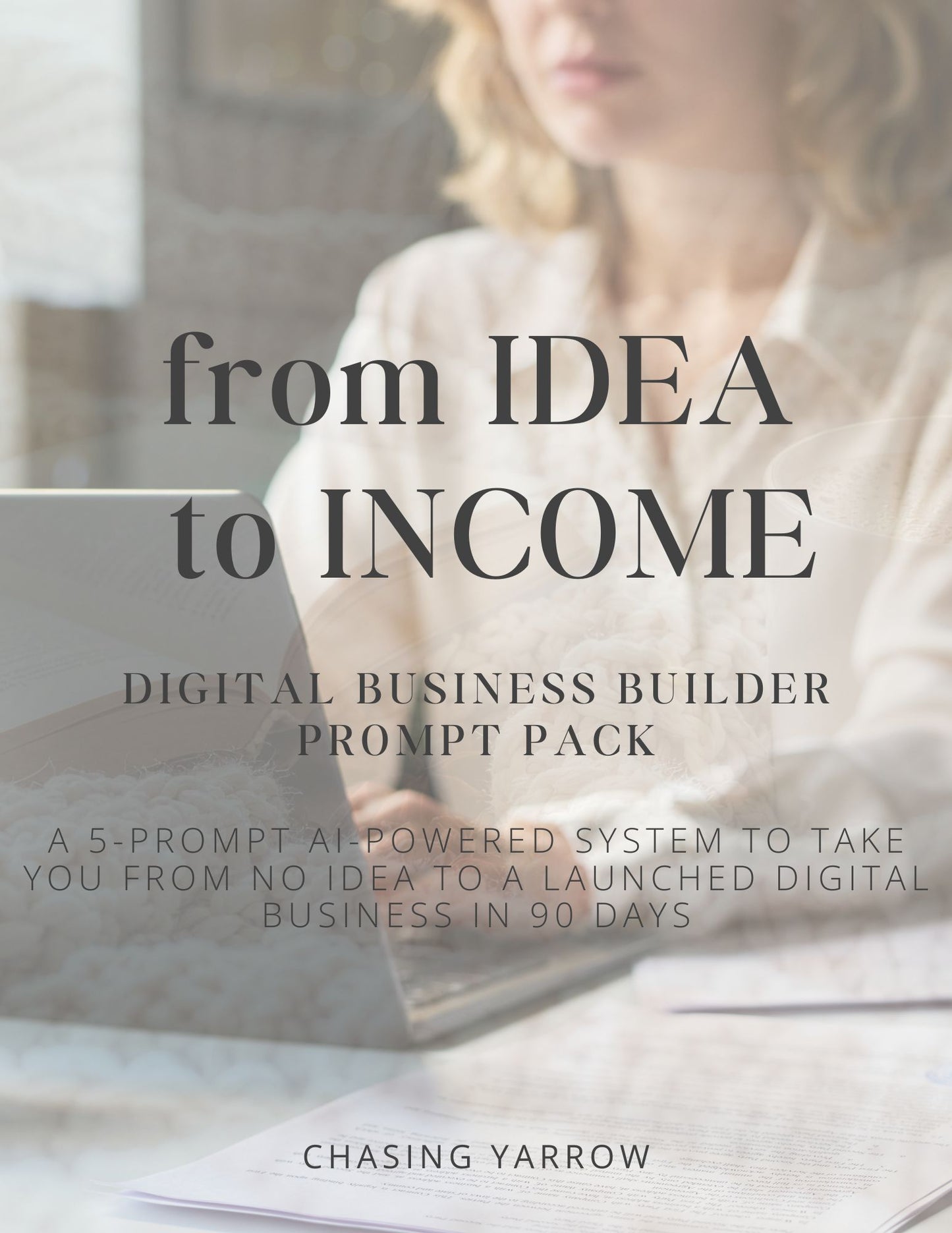
From Idea to Income is five AI-powered prompts that help you find your idea, validate it, and build a real starting plan — without needing to have it all figured out first. It meets you exactly where you are.
If you're waiting to feel ready, this is how you build the readiness.
What You're Actually Risking — And What You're Not
Let's be honest about the real risk profile here, because fear often inflates it dramatically.
What you are risking: time, some money if you invest in tools or products, and a degree of visibility that feels uncomfortable at first.
What you are not risking: your identity, your relationships, your worth as a person, your ability to try something different if this path isn't right, or the respect of anyone whose opinion actually matters to you.
The online business world has a low barrier to entry and a very forgiving environment for iteration. You can start, adjust, pivot, and refine in a way that most traditional business models simply don't allow. The cost of a misstep is usually a lesson — not a catastrophe.
And the upside? An income that doesn't require you to trade more hours for more dollars. Work that's genuinely yours. A skill set that compounds over time. A voice that reaches women who needed to hear exactly what you have to say.
That's not nothing. That's actually quite a lot.
The fear is loud because it's trying to protect you. But sometimes the thing it's protecting you from is the life you actually want.
You Are More Ready Than You Feel
I want to close with this, because I mean it — not as a platitude, but as something I've watched play out again and again:
You are more ready than you feel. Not perfectly ready. Not fully ready. But far more ready than the fear is telling you.
You have real experience. You have a real perspective. You have problems you've solved and things you've learned and a way of seeing the world that is entirely your own. You have decades of credibility in the currency that actually matters online — being real, being helpful, being someone people trust.
The gap between where you are and where you want to be is bridged by starting. Not by waiting. Not by becoming more qualified. Not by finding the perfect moment.
By starting.
And you can start today — right now, with whatever you have. Which is, I promise, more than enough to begin.
✨ Ready to take the first step?
From Idea to Income walks you through finding your idea and building your first real plan — with AI doing the heavy lifting, and you bringing what only you can bring: your real life, your real experience, your real self.
The first step doesn't have to be huge. It just has to be taken.
Frequently Asked Questions
What if I genuinely don't feel like an expert in anything?
This is one of the most common things I hear — and almost universally, it isn't true. What's true is that you don't feel like an expert compared to an idealized standard that doesn't really exist. You know things other women want to know. You've solved problems other women are still stuck in. You don't need a credential or a title. You need to be genuinely helpful about something real. And you already are.
What if I start and people I know judge me?
Some might notice. Very few will say anything. And of those who do, the response is more often curiosity or quiet admiration than judgment — even if it doesn't feel that way from the outside. More importantly, the women who find your content online and feel less alone because of it? They far outnumber anyone who might raise an eyebrow. Build for them.
Is it really not too late to start at 45, 50, or 55?
Not even a little bit. The digital income landscape rewards consistency and genuine helpfulness over time — and time is something you have. Women building in midlife often grow more slowly at first and more sustainably over time, because they're building from depth rather than trend-chasing. Ten years of compounding from a genuine start today is worth far more than ten more years of waiting for the right moment.
What if I start and it doesn't work?
Then you'll know something real, which is more than you know now. You'll have built a skill set, a body of work, and a clarity about what to do differently. Very few people who start with genuine effort and consistency look back and say it wasn't worth it — even when the path looked different than they expected.
How do I know if From Idea to Income is right for me?
If you're in the phase of wanting to start but not being sure what your idea is, whether it's viable, or how to turn it into an actual plan — it was built for exactly that moment. The prompts walk you through a complete discovery process so that you leave with a real starting point, not just inspiration. It's $47 and available right here.
Do I need to already know what kind of digital business I want to build?
No — and in fact, if you already know exactly what you want to build, you may be ready for a different resource. From Idea to Income is specifically designed for the woman who is still figuring that out. The prompts help surface what you know, what you're drawn to, and what problems you're best positioned to solve — and then build a plan around those answers.